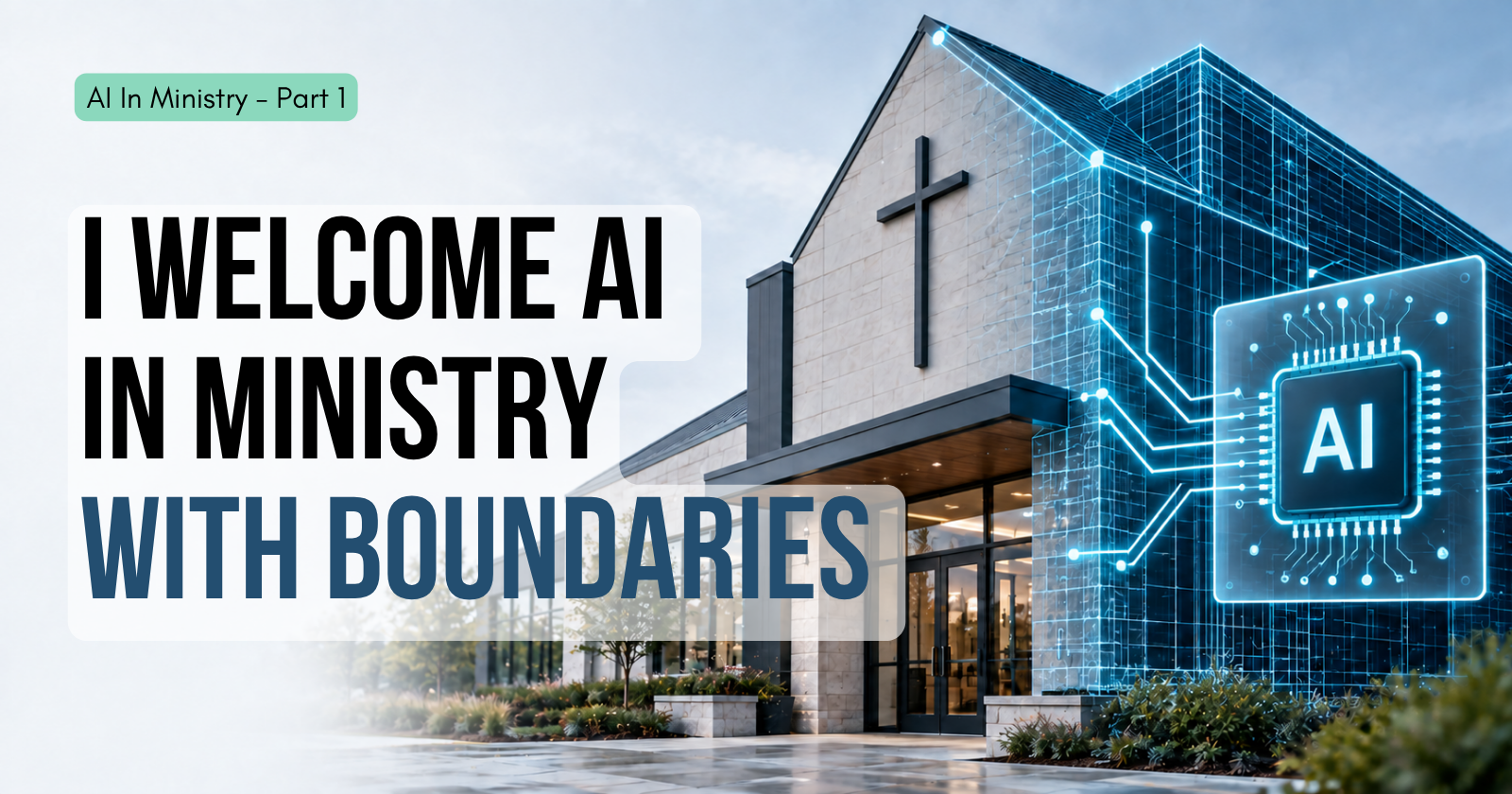
Do you feel nervous about using AI in your ministry?
You’re not imagining that tension. Half the apps on your phone already lean on AI: the calendar that finds a meeting time, the autocomplete finishing your texts, the tool a volunteer used to clean up Sunday’s bulletin graphic. Almost nobody is starting from zero anymore. The real question was never whether you’re using it.
“The real question is whether you’re using AI well, and whether you’d be at peace if your elders saw exactly how.”
“The real question is whether you’re using AI well, and whether you’d be at peace if your elders saw exactly how.”
That uncertainty matters more in a church than almost anywhere else. A bad AI habit at a business produces an awkward email. A bad AI habit in a church can quietly erode the trust a congregation places in you to be present: writing the message yourself, praying over the decision yourself, showing up in the hospital room yourself. So, before I make the case for AI in church administration, here’s exactly where I draw the line.
AI in Church Administration, Not Shepherding
Here’s the distinction I use, and the one I’d encourage you to adopt: AI belongs in the work that supports ministry, not the work of ministry itself. Scheduling, correspondence, document formatting, research, and administrative busywork are fair game. Shepherding, counsel, and the teaching of scripture are not.
AI can help you find forty-five minutes back in your Tuesday. It should never be the one deciding what to say to a grieving family, or what your church believes.
That distinction is also the safeguard. When it comes to integrity, the church has called you as pastor to interpret and preach the word. The church has called you to counsel and to teach. AI can still help you structure and proofread, but your pastoral duties are derived from communion with God, not just theological points that AI can write. If we are to remain above reproach (1 Timothy 3:2), we have to keep the administrative and the spiritual in separate lanes.
“If a tool does your administrative lifting so you have more time with people, that’s stewardship. If it does your theological thinking, that’s a problem, no matter how good the output sounds.”
If a tool does your administrative lifting so you have more time with people, that’s stewardship; if it does your theological thinking, that’s a problem, no matter how good the output sounds.
What AI Actually Takes Off Your Plate
In practice, the administrative category is bigger than most pastors expect:
- Scheduling and calendar management. Finding a time that works across three staff calendars and two vendor availabilities, without the six-email back-and-forth.
- Email triage and drafting. Setting up daily automations that sort what needs your attention from what doesn’t, and producing a first-pass reply you edit rather than write from scratch.
- Documents and presentations. Formatting a board packet, cleaning up a budget spreadsheet, turning bullet points into a clean handout for a team meeting.
- Web and email design. Getting AI to provide the HTML and CSS behind a newsletter or a landing page section, and handling the formatting you would spend hours on in a drag-and-drop editor.
- Research. Pulling together comparison data for an insurance renewal, getting community demographics, or setting up alerts for community events to help you stay present.
- Shared Instructions. Create a common set of AI directions you share with your team to keep branding, reports, and formatting consistent.
None of that touches the pulpit. All of it touches the part of your week, upward of 40%, that currently goes to budgets, emails, and leaky faucets instead of sermon prep and people.
The Math Most Churches Are Missing
A general-purpose AI subscription runs about $20 a month. For that price, a solo pastor or a two-person staff gets something close to the combined output of an administrative assistant, a marketing assistant, and a research assistant. This is not a full replacement for any of those roles, but real capacity you don’t currently have and likely can’t afford to hire for. And yes, it’s worth the $20 once you learn how to use the system.
If you’re a normative-size church, under 300 attendees, that’s not a small thing. It’s the difference between a task sitting undone for three weeks and getting handled the day it lands in your inbox.
You’re Called to Shepherd People, Not Process
Every hour AI gives back is only worth something if it goes toward the people and the preaching you were called to.
We can get so caught up in the office work of ministry that we miss the people we’re called to minister to. Don’t let that happen to you. If a tool saves you three hours this week, protect those three hours for a hospital visit, a sermon that isn’t rushed, or dinner with your family.
One Quick Way to Start This Week
If you want a low-risk entry point, start with your inbox. Most AI tools can now connect to your email, and you can grant read-only access if you’re not ready to hand over more.
Ask it to sort incoming mail into “Needs Reply,” “Needs Review,” and “Delete” folders. Reducing the time you spend filtering your emails at the start of the day. You can go a step further and have it give you a short daily summary of what needs your attention right away.
Once you’re comfortable, take it a step further and have it draft replies for the messages that need one. These replies sit in your drafts folder for you to review, edit, and send yourself. You stay the one who decides what goes out. You just stop being the one who has to compose all of it from a blank screen. That one habit, done consistently, will save most pastors more time than anything else on this list.
One more tip: if you routinely get sensitive information, like counseling notes, in your email, set up two email aliases: one public address that AI can review, and a second one reserved for counseling appointments and sensitive conversations, such as with your elders, that AI never touches.
As always, review everything before it goes out under your name or your church’s name.
“You didn’t answer the call to ministry so you could manage the business of the church. You answered it to shepherd people.”
You didn’t answer the call to ministry so you could manage the business of the church. You answered it to shepherd people. Let the tools that can carry the paperwork carry it, and keep your hands free for the people God has entrusted to your care.
If you want help figuring out where AI actually fits in your church’s administrative workload, and where it shouldn’t, schedule a consultation with Church Logistics Consulting.
About the Author
Rick Theriot holds an MDiv and is an ordained minister. Before founding Church Logistics Consulting, he served in children’s ministry, guest experience, and as an executive pastor. In each of these roles, he saw ministry take a back seat to ministry work. Church Logistics is a platform that supports pastors and frees them to spend more time shepherding their flock.